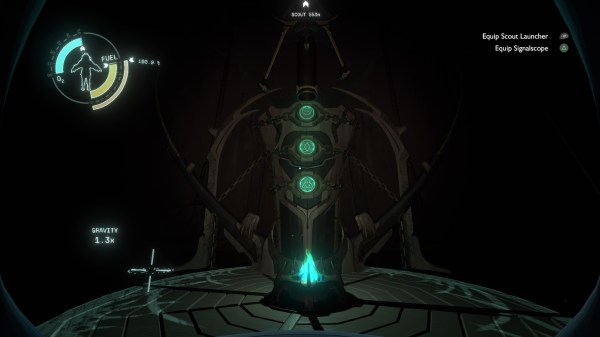
Outer Wilds: Echoes of the Eye – A Very Different Return

When I first saw the trailer for “Outer Wilds’” first and only expansion, I was curious. The trailer showed very little: dark spaces and mysterious structures, things not entirely unfamiliar to the base game, yet portrayed in a way the game hadn’t really done. The trailer focused on a sense of dread both in the shots and the way the music was composed, something closer to the likes of the “Alien” film’s famous siren trailer. I was excited for more in this world but wasn’t sure I would be able to handle this change in tone as a notorious coward when it comes to horror, especially things emerging from the dark. As such, I steeled myself and waited patiently.
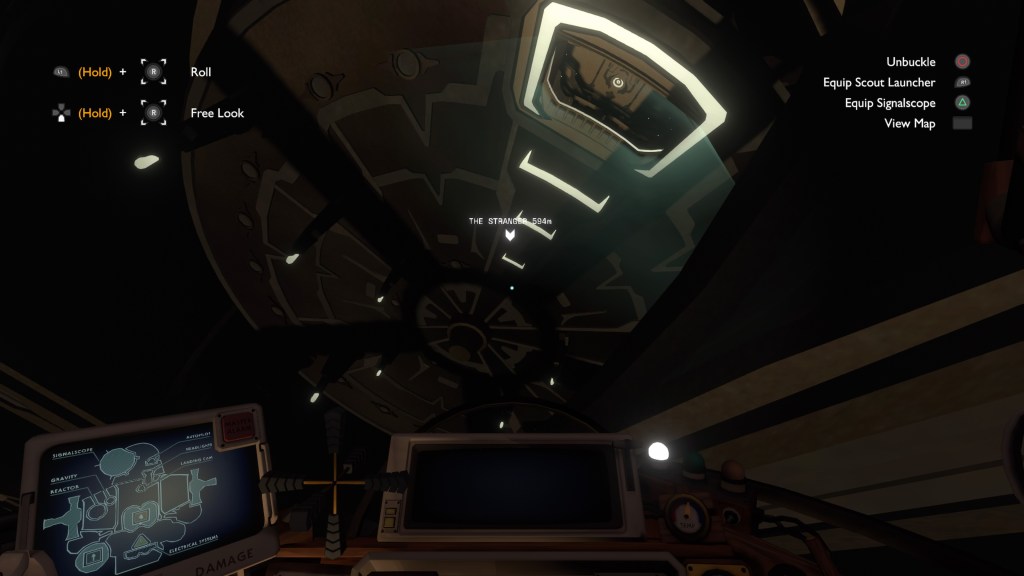
An image of the circular Stranger structure from the outside
The Stranger looms large over the solar system and your ship, concealing secrets and strange devices.


On September 28, 2021, the DLC quietly released and I dove in, excited but found myself engaging with something even more different to the main game than I expected. The general “Outer Wilds” vibes are there: scouring a mysterious astral body to discover secrets and understand what it does and why but the other vibes are gone. No more reading letters from the Nomai people to one another establishing their personalities and goals with your handy translator tool. In “Echoes of the Eye,” The Stranger, a structure appearing in a cloaking device in the familiar solar system, found through a pretty good “Outer Wilds-y” navigation puzzle, is filled with a language our Hearthian protagonist cannot translate, let alone understand and instead, scattered throughout the empty, wooden halls, are slide reels. The implication is simple: the Inhabitants of The Stranger, a species of Owl-people with Elk horns, who are as cute as they are vaguely spooky, seem to be a much more visually communicative people than the habitually notation-making Nomai from the base game. Most of their instructions are done through the slide reels, including the biggest mystery of the Stranger: why are there slide reels with information burned out in some places and where did all the inhabitants go? The latter is answered pretty quickly in your tour of the Stranger as you discover rooms with the decaying skeletons of what remains of the people onboard. Fear is a major theme of this adventure.

The Stranger’s denizens portraiture decorates many of the structures within. Some sweet, some spooky.


This DLC differs from the base game heavily in both tone and mechanics. The base “Outer Wilds” experience was signposted by going to planets and exploring whatever caught your eye on the game’s 22 minute loop. Learning what you can and going wherever you think a new clue might be. “Echoes of the Eye” has you heading to the same place and scouring sections of it for slide reels to point you where you need to go. The signposting and points of interest, as a result, are much harder to pin down in Echoes of the Eye. This is especially true when the game drops you into the Shadow Zone on your investigative journey. Stripped of your friendly jetpack and flashlight you are popped into a realm of pure darkness where the only tool you have to navigate is a mysterious lantern-like artifact. Limitation in movement and pitch black navigation is the name of the game for the bulk of the journey, all the while looking out for and avoiding the residents in this new phase who are not so happy with a new intruder walking around their special home. Despite their displeasure with you, however, should you get caught by them while holding your trusty lantern, they will simply blow out the flame sending you back to where you entered the space. This is the primary loop you will experience in depth: Find things in the one part of the Stranger to guide you in the other, wander the darkness and try to make your way without getting caught until you figure out what the denizens are doing here and why.
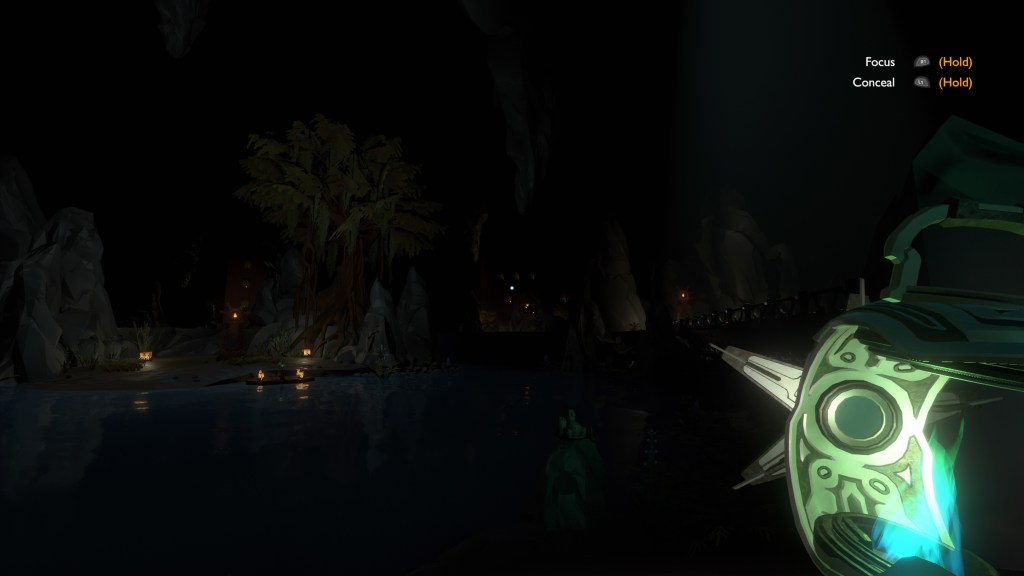
Within the Stranger, a great many secret areas, cloaked in shadow await.


There are aspects to this, unfortunately, that are more trying than they are intriguing. While wandering the darkness you have two options to use your lantern: Conceal and Focus. Conceal hides your flame from would be pursuers and Focus shines a powerful beam in front of you both showing you paths ahead to maneuver and also lighting candles and other light fixtures caught in the beam. However, the speed you move while doing either of these things is far slower than just walking, which makes the backtracking aspect of these phases of exploration a little annoying. Another issue is that most of your tools are useless for a majority of the game. The signal scope which lets you tag and track your distance from unique sound frequencies is only used to hunt down the satellite at the very beginning. The translation tool is unable to read any of the language of the Stranger’s denizens, despite appearing every time you approach one of their signs and the writing upon it. The Scout sees much more use as it is able to help you see into collapsed rooms, turn on an artificial light source while looking for a more suitable one, and see if any of the pesky haze of death that is Ghost Matter is lurking about to maneuver past it. However, even then, the second you are in the other realm of the Stranger, all these tools are inaccessible. Another complaint is that, since you land your ship on the Stranger and spend the entire time moving around the ring-world within, you don’t return to your ship really during the loops of the DLC’s adventure, and as a result, the hopping from planet to planet that made “Outer Wilds’” core gameplay so much fun is largely absent and the Log and Journal, which points whether or not there is more to explore in a certain area is largely inaccessible for your time on the Stranger, which is a major hassle in terms of exploration and knowing where to go next.
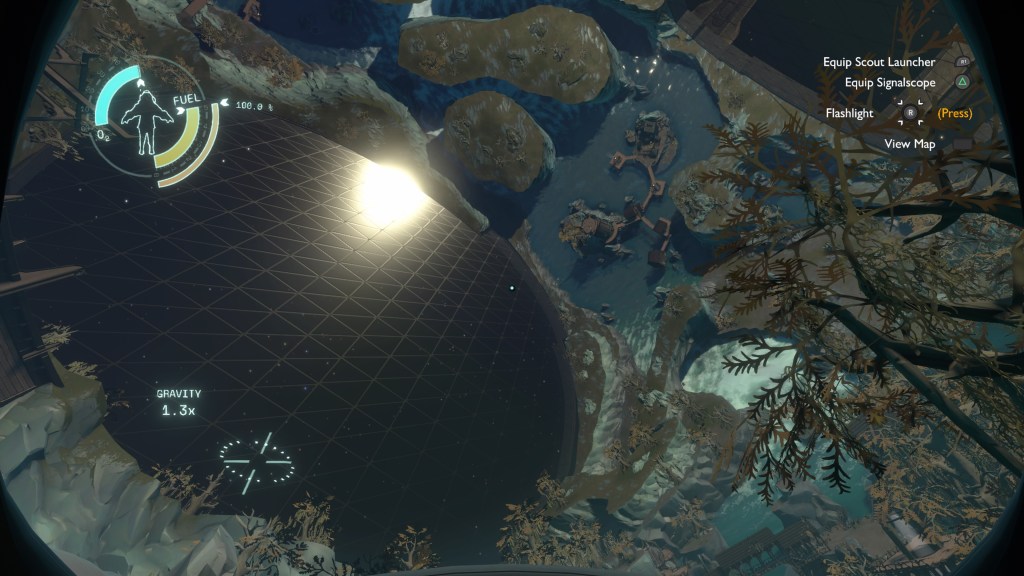
The ring-world of the stranger has a lot to see and places to go.


The story of the Stranger and its inhabitants also suffers from the differences. With the Nomai and their writings, you could consistently get a sense of the personalities at play. Each one shining as an individual character with their own take on the events transpiring around them. The Inhabitants however, are afforded no such individuality save for a few instances, including one at the very end of your journey through the Stranger. As in their slides, they are a very visually communicative society, it would appear, and their story, while tragic, doesn’t afford that individual level of sadness that the fates of the Nomai and your Hearthian friends do. As hard as it is to get attached to something with only 22 minutes to get to know them before the sun blasts you to kingdom come, or, like me you accidentally fly your ship into the sun trying to do a cool landing trick, the base game succeeds in many ways that, save for your encounter at the bitter end of your adventure, doesn’t seem to have been a main concern for the Mobius Digital team in the expansion. The design of the Stranger and its inhabitants also seems to borrow from the art of the Native American people of the Pacific Northwest which has some implications that may or may not have been intended with the story of how they came to be in the solar system and why, as well as their design evoking a folkloric monster of the Algonquin people, that leads to me thinking there were some slightly ill considered decisions made for the aesthetics.
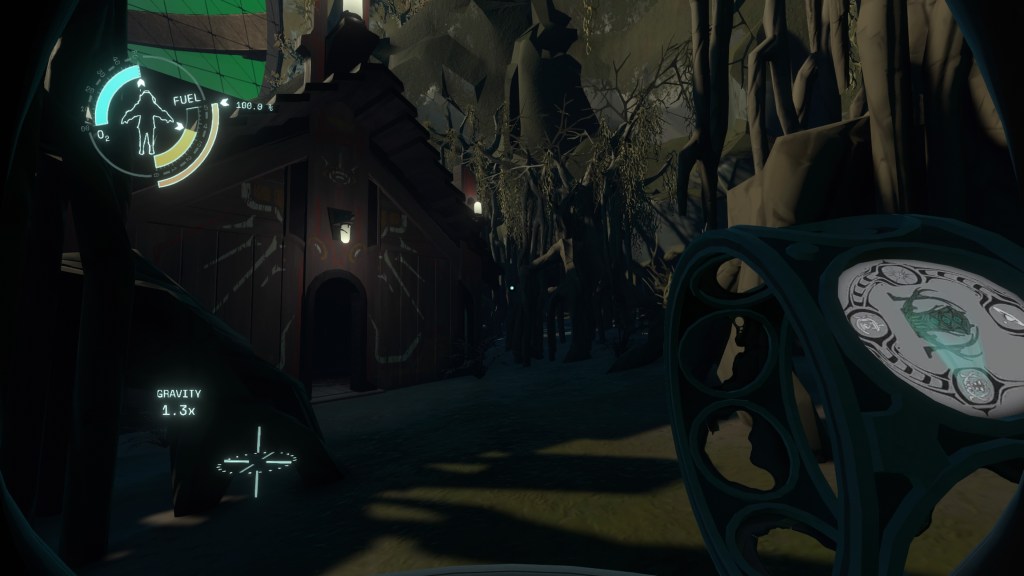
The paintings on the walls of the Stranger’s denizens’ buildings echo Pacific Northwestern Native American artwork.


Even with these marks against it, there are so many aspects of “Echoes of the Eye” that do work extremely well. The new instrumental tracks composed by Andrew Prahlow have that same twang and charm but with new layers in the sounds that enhance the atmosphere of the Stranger and the world within. Inclusions of choral music to help set the vibe of the Stranger and its denizens enhances your time on the stranger and suffusing small moments with a mysterious dread and a somber beauty. The theremin inclusion as the main instrument of the denizens also enhances the mildly haunted-mansion vibe of the areas you encounter them in and is used for an incredibly touching finale to the whole experience. Once things start clicking together and the general mechanics begin to unveil themselves to you, as well, the experience in “Echoes” goes from one of, in my case, jumping at shadows and getting frustrated at your ignorance, to smiling at yourself and punching little holes through where you thought there would be no possibility before. The story of the Stranger may not hit as hard as the Nomai’s struggles from the base game for many, but the tragedy of these wanderers got me to my core and the things I uncovered by the end culminated in a short little sequence that, despite its brevity, did the thing I love the most about Outer Wilds: creating a brief moment of companionship and closure between two people from almost incomprehensibly different worlds without a single spoken word.
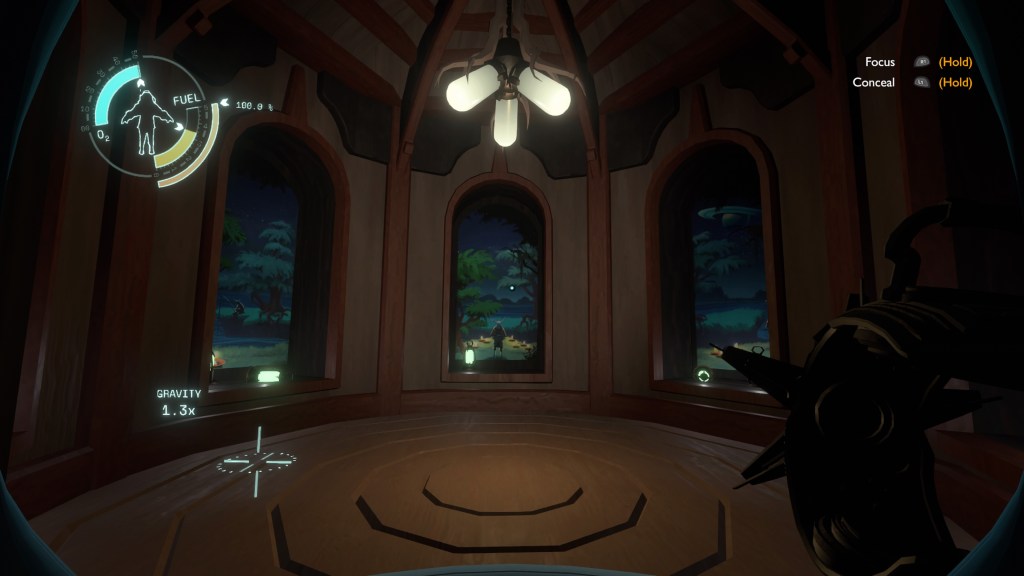
Paintings and Slide Reels tell the story of the Stranger and how it came to be, as well as the tragedies within.


I spent a large chunk of the 8 hours I wandered through “Echoes of the Eye” scared, as a tremendous horror game coward. That dread was the intrinsic feeling through most of it, but even then I had the same joy in cracking the logic puzzles as I had in the base game, even as slightly more frustrating as the adventure was. I can only have hope that, whatever the Mobius Digital team puts their sights on next, it will be as engaging and fascinating as the displays of creativity and feeling that, even without a single word of text or line of dialogue, carried through the Echoes.

“Final Fantasy VII Remake” Review

An Advance Warning: This review contains major spoilers for “Final Fantasy VII Remake”

Opening

“Final Fantasy VII Remake” summons complicated feelings. At its very best it redefines what is to be expected of a video game remake and delivers a stunning experience worthy of the legacy it hefts along with it like the oversized Buster Sword of its protagonist. At its worst it is annoying, frustrating and hampered by the format and the technology it is forced to exist upon, alongside confusing story choices that don’t so much remake as create this game as a sequel. Not only to the original “Final Fantasy VII” of 1997 but to the extended universe “Compilation of Final Fantasy VII” including such mixed entries as “Dirge of Cerberus,” Gackt’s starring role in “Crisis Core” and the film “Advent Children” that delivered on crazy spectacle fight scenes but very little else thematically, in my experience. 

The Remake of “Final Fantasy VII,” One of the most beloved RPGs in the history of the medium of video games was going to disappoint people one way or the other. The creative team behind Remake includes some of the most successful but also most notorious developers of modern Square Enix, including Tetsuya Nomura, of “Kingdom Hearts” fame and infamy, Shigenori Nojima, who penned the script for the original as well as most of the Compilation content, and Motomu Toriyama, the director of the Final Fantasy XIII Series, which this game borrows heavily from both thematically, environmentally, and mechanically.

  Overall I find this game to be perplexing. I like a lot of it but some little things here and there trouble me both for the future of this series and the direction of Final Fantasy in general. What is unequivocal is that this game should not be your first exposure to Final Fantasy VII for many reasons, between some scenes just outright assuming everyone knows who every character is and what they’re about and how the very ending shakes out. 

Active Battling

To begin with, when the game is in its full glory of gameplay, it works miraculously. Adapting the turn based system of the original into a free flowing action combat system where attacking builds up charges of ATB, bars of energy that you then expend to unleash special attacks with effects from big damage attacks, magical spells, and other, more mechanically intense abilities. Cloud, the hero, plays as a free from swordsman swinging that Buster Sword like there’s no tomorrow with an emphasis in his abilities on big hits and pressuring enemies. Pressure and Staggering enemies are integral parts of the system of combat on display. Hitting enemy weaknesses and doing big damage builds up a bar for the enemy that, when full, multiplies their damage taken by an enormous amount. Tifa, the most mechanically intense party member who specializes in charging her attacks with her Unbridled Strength ability and then unloading with speedy, ever-chainable combo attacks with abilities that can raise the stagger gauge’s percentage sky-high letting the damage she does go even higher. Barret, the eco-terrorist with a heart of gold uses his mechanical gun arm to dish out ranged attacks and use his Lifesaver ability to cover the rest of the party and absorb the damage. Aerith, the mystically inclined florist uses magical buffs and arena marks to increase the effectiveness of her friends or take out powerful foes from afar. In addition, Final Fantasy VII’s Materia system is kept very similar to its original format allowing you to customize every character how you wish with an arsenal of familiar spells like Firaga, Stop and other Final Fantasy staples to new Materia equipments for the new system like improving the block, an evasion counterattack, and so on and so forth. 

The combat system is easily the highest point of the game with fights ranging from simple grunts to titanic summon beast providing equal amounts of enjoyment just due to how good it feels. Unfortunately it runs into a few hickups. Flying enemies, for one, tend to be more annoying than fun to fight in nearly every aspect. Unless you’re playing as Barret or Aerith, you’ll be unable to hit them outside of a simple jump to slap series of basic attacks and neither Cloud or Tifa have any special abilities that don’t consume MP that can actively hit the monsters midair. I’ve noticed times when enemies are on walls just high enough to where you cannot hit them with normal attacks but they also simply refuse to jump to hit them. This is odd because previous attempts at this type of game including “Kingdom Hearts 3,” and “Final Fantasy XV.” Too many times during big spectacle boss fights have I just staggered the enemy and hit it once before a cutscene starts and makes it impossible to capitalize on the weakened state. God forbid this happens to someone who had just opened up with a Limit Break, wasting the super powered move and every second of the sumptuous animation work put in. The in-battle cutscenes are beautiful but sometimes they can make simple fights take a bit too long as well. Getting to the battles is yet another issue that somewhat mars the game, especially on a second or third playthrougjh, which the game really wants you to do with the amount of dialogue options and the variance in sequences that can change depending on how you play the game. If you’re not a fan of the “Squeeze through Tight Space” school of loading screen disguise or the forced walk-along with this character talking to you then this game may begin irritating you very quickly.

Steel Skyline

A lot of the sequences in this game are wonderful to behold, especially in the more open zones of Midgar where the work done with the Unreal engine shows an astonishing attention to detail, even on launch spec Playstation 4 systems. It’s not without its hiccups. Some textures refuse to load and the models, especially those of npcs and scene setting props, are noticeably less impressive than the models of the main characters. Some backgrounds are a little more obvious than others in their flatness with an egregious example happening during Chapter 15 amidst a really stunning view of the city of Midgar at sunset which kind of marred the moment. Barret says “Don’t you ever forget this view!” as Tifa, Cloud and himself stare out over the destruction

The enemies you fight along the way, however are all rendered in glorious detail with some of the more grotesque creatures now showing their true colors in full 3d models with horrifyingly realistic textures. In particular, the mechanical monstrosities the Shinra Corporation send after Cloud and friends are rendered with such intense detail and during fights you’ll see every individual part of the model moving and shifting, especially in the realization of the Hell House, one of the goofier random enemies in the original, which has now been giving a full boss fight with scene transitions and multiple phases. The cast of capitalists that compose the Shinra Company’s board of executives are all Hi-definition in their hateability from Professor Hojo, who looks just as greasy and creepy as you could have imagined, to Rufus Shinra, the vice-president who has been given the same visual upgrade as the main party, complete with double custom shotguns, and mall goth skirt pants. 

Some of the important npc’s however, don’t quite achieve that cohesive style and it is kind of obvious which ones are drawing from existing concept art by Tetsuya Nomura and those who were freshly designed by Roberto Ferrari, a Square nix character designer who has worked on Final Fantasy Type-0, The Last Remnant, and Final Fantasy XV before this undertaking. His designs tend to skew more towards the modern realism rather than the dieselpunk-esque 90s aesthetic that Cloud, friends and enemies walked out of. The inconsistency in style between the main party and the major antagonists as opposed to the average citizenry and many of the characters you help out is very noticeable but it seems to be an issue that has existed since Final Fantasy XV where the delineation between Main Character and Not was made abundantly clear which is a shame because the unique art style of the original looks great updated with modern sensibilities. 

Another issue is that the level of detail in the environments not only require a lot of the aforementioned load squeezes and makes me wonder how this engine and team will create the more open locations in the latter parts of FF7.

Old Faces, New Words

The most controversial things about this game are all in the way it handles its story. From new segments that expand the narrative of the original and try to flesh out some of the side characters, to entirely new set pieces and areas that replace old segments or are entirely new. The best additions come in segments like walking Aerith back to the Seventh Heaven bar to try and find Barret’s daughter Marlene as the rest of the gang fights their way up the Sector Seven pillar. This bit shows both how she was captured by Tseng and the Shinra, and gives us one of the most heartbreaking sequences in the game between Marlene and Aerith as they confront the fact that Marlene’s home is about to be no more. Another entirely new section that felt like a logical addition was the expansions to Shinra Tower up until Hojo’s laboratory. The museum of the grandeur of Shinra, with the exception of a monkey bars segment, both had some in depth world-building in the way Shinra operates in the eyes of the public through corporate propaganda-filled tours through their various department, to a VR theater showing the Shinra interpretation of the history of the Ancients. The visual spectacle is, again, off the charts, which is to be expected with the amount of money that Square nix seems willing to pour into these “7 Remake” series games. 

Some sequences, unfortunately, overstay their welcome. A set piece involving a construction arm crane repeats around 3 times with the gripping gameplay of picking up and moving boxes around in a segment that lasts for about an hour on your first go-round, where originally it was just a cute world-building background detail as you made your way through a single screen. The expansion to the train graveyard unfortunately does the same thing , but in a worse way. For about 2 hours of gameplay you are chasing ghosts of children around the graveyard and dealing with comedic hi-jinks centered around Tifa’s fear of ghosts. Meanwhile, not a mile down the road, the rest of Avalanche are engaging in a firefight for their lives. What feels like a diversion simply detracts from the pacing and makes the section feel more like padding than anything else.

The inclusion of characters from the compilation novellas in characters like Leslie, Kyrie, and Mireille offer the only interesting side content but overall, with the exception of Leslie directly helping the Avalanche crew during the events at Wall Market, none of them really make much of an impact on the story and partake in some of the more obvious filler content between chasing a pig beast through the sewers and engaging in investigations and fights against variants of regular enemies. The same can be said for most of the characters in these side-content things. They don’t really contribute much aside from reminding the player that yes people are here in Midgar.

Many major characters, in addition, have engaged in a bit of an overhaul. From Reno and Rude, fan favorite members of the Turks, getting more screen time and sequences where they ruminate on the cruelty of their actions, to the Avalanche crew having more things about them from Biggs volunteering at an orphanage and treating Cloud like a little brother, to Wedge and his cat gang to Jessie being fleshed out as an aspiring actress with some really deep-set Mako Reactor-related family trauma that spurs her Avalanche activities on, despite most of her dialogue just being how horny she is for Cloud. Aerith, especially, gets more chances to show more than one side of herself, quickly becoming one of my favorite characters, almost from minute one. But that first minute comes with the introduction of one of the most overwrought aspects of the remake: The Whispers of Fate.

The Ghosts of What Came Before

The Whispers serve a very straightforward purpose: to keep the plot of the game on track with the plot from the original, either through actively putting characters in the situations they should be, dragging others off screen, causing accidents or even straight up breaking Jessie’s ankle to make sure Cloud is the one on the Reactor 5 mission. They seem to serve as a meta commentary on the fans who only wanted a game called “Final Fantasy VII Remake” to be just that: a remake of the game. Treating them as a force of nature willing to do whatever it takes. The theme of fighting fate is a familiar one to Final Fantasy, especially in the XIII Trilogy that most of the team directing 7 Remake worked on, and the possibilities of a “Final Fantasy VII” full of things happening differently has me excited. However the constant interjection of the Whispers into the plot just serves to be little more than shoving the player’s face into it.  

The other problem is, the original Final Fantasy Seven, for as polygonal and pre-rendered it was had a lot of love and charm in it that i can see this blatancy with the team in the Remake souring the time of many really hard-core fans of the original. It’s a double-edged sword. A desire to do something new is always welcome but it’s a dangerous tightrope to walk when dealing with something as important to the medium of video games as “Final Fantasy VII.”

The killing of the entire concept of destiny at the end of “VII Remake” takes this concept to its logical extreme and waves its victory triumphantly even though it was never an enemy, I personally, thought needed to be outright killed in this fashion. And for a game that seeks to run a separate course from the original and the “Final Fantasy VII Compilation” content, it sure loves to draw heavy bits from it, even Sephiroth, that most iconic of Final Fantasy villains. If you are unfamiliar with “Final Fantasy VII” in its entirety, nothing about Sephiroth will be understandable. His motives are never explored, we never see why he is the way that he is and instead he chooses to speak in cryptic hints to things that might happen in future installments and gets really, really close to Cloud. Everything about Sephiroth hinges on familiarity with previous incarnations of the character which makes this game have way more required previous viewing than a lot of people were expecting, including me. You may not be able to have a “Final Fantasy VII” piece of media without Sephiroth due to his omnipresence in the popular conscience surrounding it but for all the show “Remake” puts on about cutting the ties to the paths previously walked it sure does lean on those ropes at nearly every turn.

The Reunion to Come

For all its faults and irritations, “Final Fantasy VII Remake” has a lot to love. From the blend of turn based and action combat to the revitalizations of characters that turned liking to loving for a large number of the cast. This is a tremendously ambitious undertaking and the things that the development team are trying to do with this installment and the future have me interested but terrified. It’s not a flawless experience and many of the aspects from padding side quests and textural issues have me worried about how or if they will even attempt to move forward with the more open world of the post Midgar segments of the original. With the ending, especially, the game has made any sort of prediction for what will happen next has gone out the window and I am cautiously hoping for the best. In the mean time, what we have as it is represents a bold step into the unknown but we will simply have to wait and see what comes and, to quote the announcement trailer, whether it will bring joy or fear.

Score: 7(oy)/10

Blog at WordPress.com.

Up ↑